



DR Hub: PJM demand response, automated
Automate demand response
When PJM calls demand response events, participants register through their CSP on PJM’s portal. DR Hub starts from those registrations: it downloads them by API, validates them automatically, lets your team review and control the outcome, and uploads the statuses back to PJM. The same cycle runs for settlements.
Built for Utilities and market participants that validate PJM demand response registrations and settlements for one or many operating companies.
How it works
How DR Hub Works, From PJM to Validated Upload
- 1
DownloadDownload from PJM
Registrations, locations, extensions, settlements, claims and CBL data are downloaded from PJM by API for each company workspace.
- 2
ValidateValidate automatically
Oracle stored procedures compare every item with the utility’s own records and mark it to accept or deny, in bulk.
- 3
UploadReview and upload
Reviewers work through selected or all records, approve or deny with comments, and the statuses upload back to PJM.
Featured application
DR Hub Automates the Review PJM Requires of Every Utility
The utility must validate every demand response registration and settlement that comes from PJM. DR Hub does it from download to validated upload.
01Where DR Hub fits
- 1PJM calls a DR eventPJM
- 2CSPs register customer sitesCSP
- 3Utility reviews registrationsAutomated by DR Hub
- 4Meter data is submittedCSP
- 5Utility validates settlementsAutomated by DR Hub
- 6PJM settles and paysPJM
02See it work
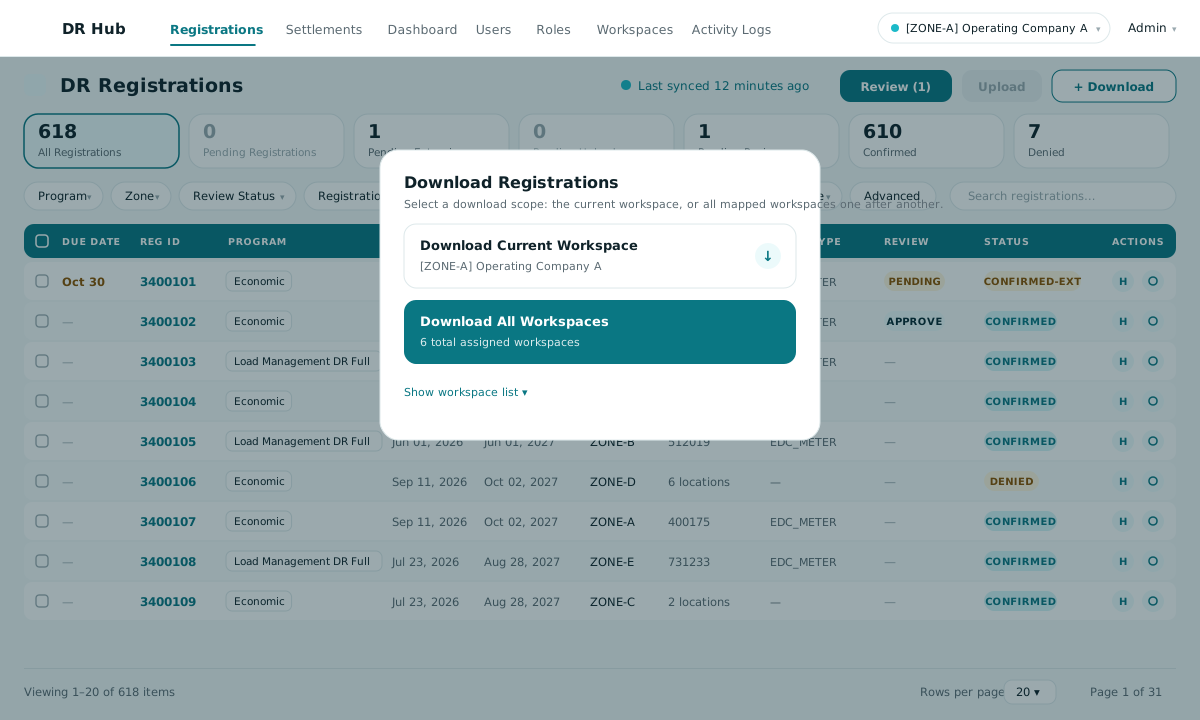
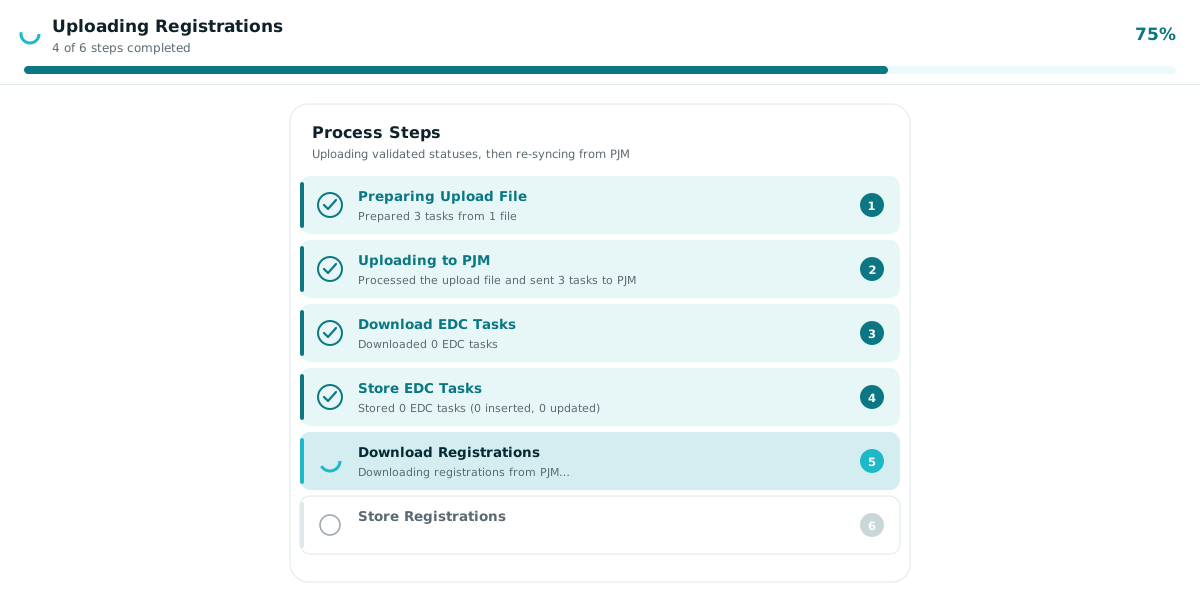
Pending registrations are pulled from PJM by API and stored in Oracle
Pending registrations and their EDC tasks are pulled from PJM by API and stored in the database, field by field, for one workspace or all of them in turn.
- PJM API
- Token and certificate
- Stored in Oracle
Button in the appDownload Registrations
03Capabilities
Two-way PJM integration
DR Hub does not register customers; that happens in PJM’s portal through CSPs. It connects to PJM by API to bring the data in, shows when each workspace last synced, and sends decisions back.
- Downloads registrations, locations, extensions and EDC tasks
- Downloads settlements, settlement info, claims data, CBL calculations and load data reviews
- Uploads validated registration and settlement statuses back to PJM
- Over 100 hours
- of manual work to review 500 settlement claims
- About 10 minutes
- for the same 500 claims with DR Hub
Illustrative screens with sample data. Figures from the published case study.
Product tour
The seven screens your team works in
01 / 07
Dashboard
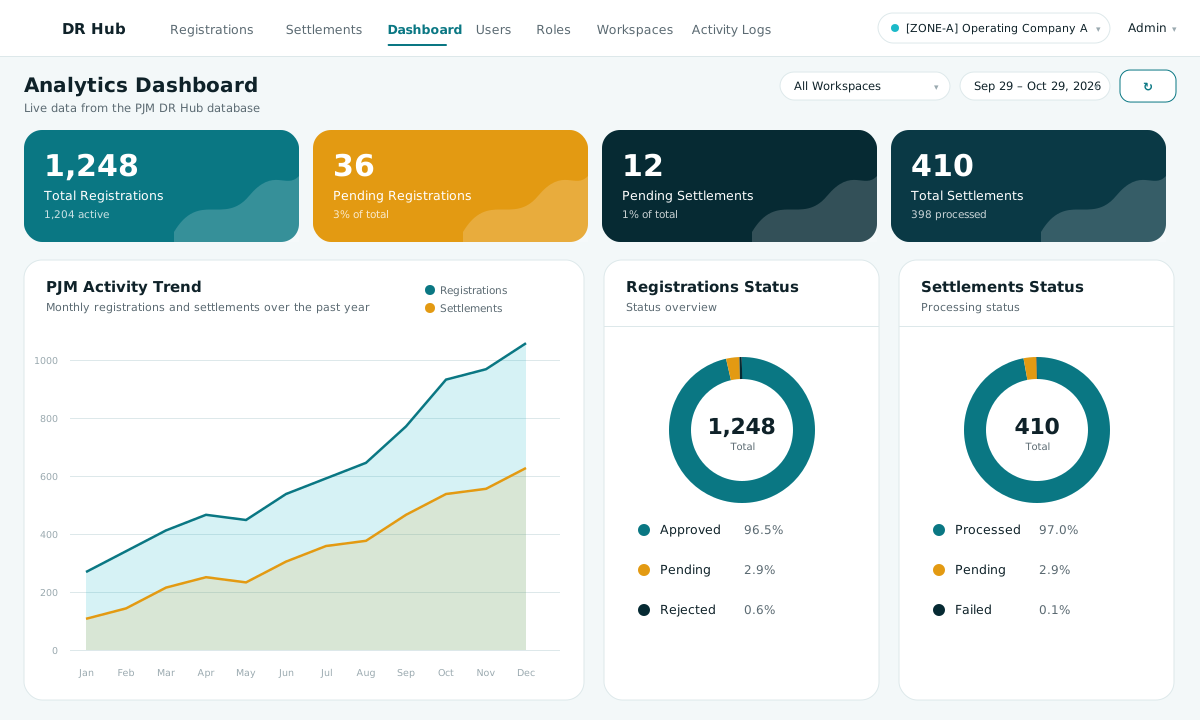
Totals, the monthly activity trend and the status mix for registrations and settlements, filtered by workspace and date range.
Case study
Delivering an Automated Solution for Managing PJM Demand Response Programs
A leading electric and natural gas utility in the northeastern US and member of the PJM Interconnection.
Download the case studyPDF · 488 KB- 01The client
The utility’s team of experts manages operations involving wholesale billing, credit, and settlement to enable electric deregulation and to support energy efficiency programs.
PJM’s demand response (DR) program lets providers offer end-use customers the ability to reduce their usage in exchange for compensation from PJM’s wholesale markets. Participating providers must meet certain requirements to qualify for wholesale payments.
The utility’s team validates PJM DR program registrations and settlements in its zone through PJM’s DR Hub, and had used a third-party vendor to perform the tasks manually. After an assessment, the team determined that an automated tool managed in-house was essential and engaged Rubicon Associates to develop it.
What the utility set out to do
- 01Improve business processes and increase efficiency through automation
- 02Build an in-house, long-term scalable solution that provides more transparency in the overall process
- 03Leverage existing hardware and technology used by the utility’s other production systems
- 04Modernize, streamline, and simplify the solution, including integration with the utility’s and PJM’s systems
- 02The manual process
- Requires manual login, download, and review of PJM tasks
- For each task, further searches in PJM are needed to retrieve data
- Requires complex spreadsheets with external links and macros
- Long-running queries are needed to obtain verification data and comparison
- Decisions and status for each task need to be tracked manually
- 03The DR Hub Automation Tool
- 01
Automatically retrieves and compares DR registrations and claims data from PJM’s and the utility’s systems
- 02
Provides results in a GUI as well as batch files indicating whether each registration and claim should be accepted or denied
- 03
Maintains auditability for the assessments and a comprehensive, time-based process log for user and system activities
- 04
Allows for user access and role-based authorization management
- 01
- 04The result
Before · manual, third party
100+hours
With DR Hub
~10minutes
Time to process 500 settlement claims. Each square is one hour; the teal sliver is ten minutes, drawn to scale.
What the utility gained
- Removed dependency on a third party and eliminated associated costs
- Significant reduction in overall process time
- Improved accuracy and less error-prone due to automation
- Enhanced visibility and accountability
- Reduced the need for manual querying of data and troubleshooting
FAQ
About the DR Hub
Something else on your mind? We answer every enquiry.
Ask us directlyDoes DR Hub register customers in PJM?
No. Registrations are created in PJM’s portal by CSPs. DR Hub starts from those registrations: it downloads them by API, validates them, and uploads the outcome.
What does automated validation replace?
The manual work of checking each registration and settlement against many details held in different places. The checks now run as programmatic logic inside Oracle stored procedures.
Can we stay in control of what is sent to PJM?
Yes. You choose specific records or all records, review and override with comments, and only then upload. Review and upload locks prevent conflicting work.
Can several companies use one installation?
Yes. Tenants contain workspaces, for example one per operating company. Each company’s data is processed separately or combined, with strict isolation.
How are credentials and actions protected?
Sign-in is through LDAP. Database credentials can be fetched from an enterprise vault (SecureVault). Every request is permission-checked and every action is written to an audit log.
How much time does it save?
In the published case study, the time to process 500 settlement claims went from over 100 hours to about 10 minutes.

Book a demo
See DR Hub Running on Your Own Process
Book a call and we will walk through download, review and upload with the people who built it. Need something similar? Rubicon pairs PJM, ISO/RTO and utility experts with the Rubicon Development Center’s engineers to design, build, validate and support applications for your market process.
- Live walkthrough of the full cycle
- Security, audit and multi-tenant model
- Scoping for your PJM zones and companies